1B Positioning

I have been mostly uninvolved with future-related discourse in media and academia up until the commencement of this subject. Having been introduced to futures thinking and made to address my untouched critical thinking skills, I still consider my thoughts on the future to be quite rudimentary.

Regarding the acceleration of body-modification technology, my initial position perpetuated contemporary attitudes towards body image, human capability, and humanity. Society would remain essentially the same as the present day, with a trajectory of self-improvement via bodily enhancement, but with the benefit of more sophisticated technological conveniences. Drawing from the current state of society while being mindful of ‘the amplifying/magnifying power of technologies’ (Ihde 1993), I was focused on predictive accuracy.

The research that I undertook when scanning the horizon of ‘love’ as a futuring theme focused first on AI, before shifting to biotechnology. Despite this dramatic leap in the subject matter of my research and group scenario, I found that there was an element of caution and cynicism that pervaded both. Australian futurist Genevieve Bell highlighted this ‘irrational fear of a relationship with technology’ in her seminar Magical Thinking: Fear, Wonder & Technology (stanfordonline 2013). I saw reason in her suggestion that the ‘death of magic’ in the face of science and rationality is the source of unease that prompts dystopian stories about technology.

To draw a comparison between AI and biotechnology, the legacy of the Luddites as recounted by Bell expresses the ongoing concern that new technology replaces things naturally human. In the context of biotechnology, the concern is that technologically-enhanced humans will unfairly outclass ‘natural’ humans. My group’s dystopian scenario, A Cut Above the Rest, reflects society’s obsession with biotechnology and the abandonment of individuality and authenticity for success.

In the creation of my own prototype, I came to better understand the purpose of future thinking, particularly regarding the creation of speculative objects and the narratives they imply. The future can be many different things―in the case of dystopian stories like A Cut Above the Rest, a problem is being identified that requires a solution, if such a future is to be avoided. While cynical, these narratives are not fatalistic, instead challenging its audience to address undesirable variables and steer humanity towards a preferred future instead. This productive method of future thinking altered my first impression of the discipline, which simply sought the most accurate prediction of the future.
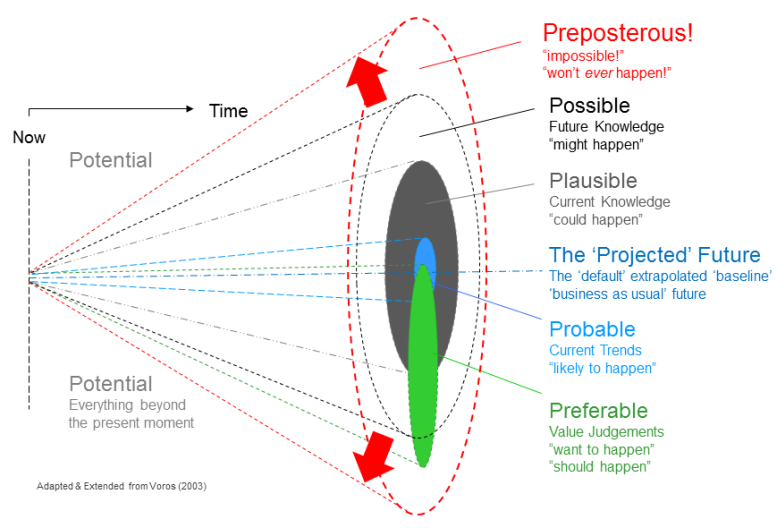
futurescone-cdb

(Voros 2017)

Rather than completely dismissing potentially unethical technologies as ‘a step too far’ and a cause for backtracking, which was my crude solution for dystopian scenarios, my primary research interview helped me address preferable futures realistically. Martin Lancaster recognised the probable and problematic trajectory of biotechnology, and instead of fighting against it, sought to direct it with notions of regulation and safety. While my position on the future of society and biotechnology is still based on a rudimentary understanding of the topic and futuring as a discipline, I believe through my research process my attitude has become more pragmatic and adaptable.

Citation

Ihde, D. 1993, Philosophy of technology: an introduction, Paragon House, New York.

stanfordonline 2013, Stanford seminar – magical thinking: fear, wonder & technology, video recording, Youtube, viewed 7 August 2018, <https://www.youtube.com/watch?v=5aKZwKFFDYw >.

Voros, J. 2017, Futures cone, The Voroscope, viewed 23 October 2018, <https://thevoroscope.com/2017/02/24/the-futures-cone-use-and-history/ >.

1C Primary Research: Interview Analysis


Martin Lancaster is a former healthcare marketing specialist who worked for international pharmaceutical company Wyeth. Prior to its consolidation with Pfizer in 2009, he was Wyeth’s regional marketing director within the Asia Pacific region for seven years (Lancaster 2018). Notable products manufactured by Wyeth include Effexor―trade name for the antidepressant Venlafaxine. While Venlafaxine is licensed for use in the treatment of major depressive disorder, generalized anxiety disorder, social phobia, and panic disorder (Australian Medicines Handbook 2013), it is also used in the treatment of narcolepsy and attention deficit-hyperactivity disorder (Stanford University School of Medicine 2007).

casebanner_wyeth

(Larmer Brown n.d.)

I interviewed Martin for his insights into the acceleration of both physical and neuro-enhancing biotechnology in the pharmaceutical industry―their marketing, regulation, ethical use, and effect on the cultural pressures of academia and the workplace. During his time as Wyeth’s marketing director for the Asia Pacific region, he was not directly involved with psychiatric drug brands or their generic equivalents, however he noted the exceptional rise in sales of pseudoephedrine (PSE). He attributed this sudden increase to its abuse as a stimulant, preceding the illegal manufacture of amphetamines.

The off-label use of certain Wyeth drugs was and remains common practice, legal when at the prescriptive discretion of general practitioners (GPs). However, when drugs are used in the complete absence of medical supervision, there is a danger that misinformation regarding side effects and dosage can lead to dangerous or even fatal consequences. Martin references Swiss physician Paracelsus (1493–1541), who laconically stated, ‘the right dosage differentiates poison from a remedy.’ He does note that there is ample information on the internet that can mitigate some of this risk. I drew a connection between this self-medicating practice and public ‘body hacking’ forums like The Immortality Institute (ImmInst.org) where members share their recreational adjustment of cognitive function through drugs and supplements (Talbot 2009).

nootropics2

(Rebel Circus n.d.)

Martin agreed that competitiveness in academia, elite sports, and the workplace has seen an exponential increase in contemporary culture, although he doesn’t believe that this will result in the commonplace use of cognitive/physical enhancers until drug regulation legally approves their use by healthy individuals. The critical barrier to their regulatory acceptance and commercial success is what Martin calls ‘an acceptable side effects profile.’ He has no doubt that in the future, science will develop drugs that surpass benefits of enhanced executive functions (alertness, attention, memory, cognitive flexibility and anti-fatigue) to target higher order executive functions (improved reasoning, problem solving, and planning). The achievement of these impressive benefits, consolidated with a satisfactory safety profile, and the post-patent price reduction on generics, is the point when the ‘performance enhancement’ market will reach critical mass.

From the perspective of someone who has observed the healthcare market shift for the last three decades, I find Martin’s future scenario to be one that maps time akin to Sohail Inayatulluh’s first pillar of futures thinking. By considering biotechnology from three dimensions―the past, present, and future― he has perceived an image of evolution and progress. That is, ‘more technology, man as the centre of the world, and a belief in rationality’ (Inayatulluh 2008).

Citation

Lancaster, M. 2018, User Profile, LinkedIn, viewed 1 October 2018, <https://www.linkedin.com/in/martin-lancaster-426a0a12/ >.

Rossi, S. (ed) 2013, Australian Medicines Handbook, The Australian Medicines Handbook Unit, Adelaide.

Stanford University School of Medicine 2007, Medications, Stanford, viewed viewed 1 October 2018, <https://web.archive.org/web/20070821090305/http://med.stanford.edu/school/Psychiatry/narcolepsy/medications.html >.

Larmer Brown n.d., Wyeth case banner, viewed 23 October 2018, <http://www.larmerbrown.com/case-studies/wyeth/ >.

Talbot, M. 2009, “Brain gain- the underground world of ‘neuroenhancing’ drugs”, The New Yorker, 27 April, viewed 26 September 2018, <https://www.newyorker.com/magazine/2009/04/27/brain-gain >.

Rebel Circus n.d., Nootropics, viewed 23 October 2018, <https://www.rebelcircus.com/blog/smart-drugs-people-pursuing-brain-enhancing-nootropics/ >.

Inayatullah, S. 2008, ‘Six pillars: futures thinking for transforming’, Foresight, vol. 10, no. 1, pp. 4-21.

Interview Transcript: Part 4

Did you notice any change in the popularity and kinds of performance enhancing drugs available during the length of your career? Do you think this has affected your company’s manufacture and marketing of these products?

During my career, the sales of pseudoephedrine (PSE) containing drugs rose dramatically. Given that this active ingredient had been on the market for many years in cough and cold medications, the sudden increase was exceptional and primarily due to the abuse of pseudoephedrine as a stimulant but more particularly as a precursor for the illegal manufacture of amphetamines.

The company introduced alternative formulations using phenylephrine (PE) instead of PSE. Meanwhile the regulatory authorities up-scheduled PSE containing medications to Pharmacist Only and requiring personal identification.

By its very nature, the abuse of prescription medications and controlled substances is difficult to quantify due to the ‘sharing’ of prescriptions, internet purchases and the illicit diversion of prescription drugs.

Only doctors can legally supply prescription drugs for off-label indications but only if there is an established medical need. Furthermore, it is illegal for drug manufacturers to promote the off-label use of prescription drugs, even if they have clinical support.

The off-label use of drugs is primarily driven by doctors who access the medical literature to seek effective therapies for their patients. Doctors will use orthodox pharmacology in the first instance but in the event of an unresponsive condition, may try off-label options.

Doctors can seek information from pharmaceutical manufacturers eg unpublished studies, but the company cannot distribute these in an unsolicited manner. The interests of the patient is paramount and the company would provide the doctor with the best available information.

While promoting off-label use of drugs is illegal, a company can always seek to formalize off label use by seeking regulatory approval for new indications with appropriate clinical support. This would naturally form part of the marketing development plans for relevant drugs.

Where do you see the development, manufacture, and marketing of performance enhancing drugs 20 years from now?

Scientific progress is unstoppable. The is no doubt that nootropic drugs that truly earn the descriptor ‘smart drugs’ will be developed with impressive benefits and safety profiles. The pricing of these novel drugs will eventually reduce as patents expire and generic copies enter the market, creating a much larger pool of potential users.

While the unknown long-term effects will still be an issue for some, the competitive nature of an increasingly knowledge/intellect driven workforce will pressure most people to conform.

This will provide huge opportunities for pharmaceutical companies to develop, manufacture and market products for a potentially massive new ‘performance enhancement’ market.

I believe the regulatory authorities will adapt to these developments by allowing the sale and marketing of drugs for non-medical, physical and cognitive performance enhancement.

Note from Martin Lancaster – ‘the opinions expressed above are mine alone and should not be attributed to any other individuals or entities.’

Interview Transcript: Part 3

Is there still value in a natural work ethic, or are neuroenhancers simply the next step in an efficient and dedicated work ethic?

Generally, patients trust their doctor implicitly to prescribe safe and effective medications to treat their health condition. They take it because they want to get well, even if they are wary of ingesting non-natural ‘chemical’ products.

I think most people would think twice about taking a drug for performance enhancement rather than for treating an ailment and would prefer a more naturalistic approach of non-drug intervention based on physical exercise and cognitive training to maintain/improve performance, with negligible risk of side effects.

However, this could change if a new generation of truly ‘smart drugs’ were developed with an acceptable safety profile. As the price of these new drugs came down, more people would seek the benefits which would in turn pressure drug-free individuals to do likewise in an increasingly competitive environment.

The biggest hurdle would be a regulatory one, requiring a seismic shift in drug regulation to approve specific physical/cognitive benefits for use by otherwise healthy individuals.

To date the Therapeutic Drugs Administration’s (TGA) position is that if a drug is unscheduled in Australia, it can’t be sold or marketed here (but can be imported for personal use (ref Personal Importation Scheme). This seriously limits the commercial potential of the nootropic market in the current situation.

The commonplace use of cognitive enhancers is probably not the ‘next step’ but will eventually happen when the pharmacology is right and the regulatory environment has responded to consumer demand.

Bio enhancements could also be expanded to include the fitness industry, where performance-enhancing drugs range from commercial supplements to the non-medical use of anabolic steroids, hormones, and stimulants. Are these two contexts comparable?

There are certainly parallels between cognitive and physical performance enhancement.

However, the use of anabolic steroids, human growth hormones and sex hormones are synonymous with cheating, personal vanity and body dysmorphia. In addition, the drugs concerned have a history of serious side effects. Accordingly, anabolic steroids are excluded from the Personal Importation Scheme. This is some heavy baggage.

If new drugs could be developed with much improved safety and ease of administration, the existing market would certainly expand in response. However, it would still be covert activity unless the regulatory authorities accept that both physical and cognitive enhancers have a place in our society for use by healthy individuals.

I think the regulatory authorities will be more amenable to cognitive enhancers given the greater value placed on intellectual ability and the historical baggage around physical enhancement and the assisted body building sub-culture.


Final Part

Note from Martin Lancaster – ‘the opinions expressed above are mine alone and should not be attributed to any other individuals or entities.’

Interview Transcript: Part 2

In competitive fields there is the risk that abstaining from biological enhancement will put you at a disadvantage. What do you envision the future of high-demand institutions will be like under these circumstances?

Employment is competitive for many workers, particularly managerial roles; likewise, academia and elite sports. Social media has also evolved a pervasive competitive dynamic that can infiltrate into almost every aspect of our social lives. These forces may have been present before but now they are dramatically amplified.

In this context, individuals will always seek ways of boosting their performance or enhancing their presentation, to give them a perceived competitive edge. The issue is, how far are they prepared to go and how this is might be regulated.

Enhancing physical and mental performance through drug intervention or invasive surgical procedures involve risks to the individual up to and including death.

It is illegal to use someone else’s prescription to access drugs or to supply a prescription medication to someone without prescription. However, the internet has facilitated the purchase of scheduled drugs from overseas and you can import unscheduled drugs such as oxiracetam (a nootropic) for personal use in Australia without medical supervision, even though it can’t be legally sold here. Interestingly Nootropil, which is closely related to oxiracetam, is Prescription Only in Australia and approved for use in the treatment of epilepsy.

Institutions that administer competition based on individual/team ability such as sports, will want to ensure fairness with respect to performance enhancing ‘artificial’ aids. These bodies will continue to enforce strict rules with enforcement mechanisms to audit compliance and deter transgression.

In academia, surveys indicate that a significant percentage of students already take cognitive enhancers (nootropic drugs) in the form of amphetamines (eg Adderall), methylphenidate (eg Ritalin), eugeroics (eg Provigil) and racetams (eg Nootropil, and oxiracetam). Perceived benefits include enhanced executive function; alertness, attention, memory, cognitive flexibility and anti-fatigue.

Improved nootropics that enhance higher order executive functions will no doubt be developed in future to improve reasoning, problem solving and planning. An acceptable side effects profile will be critical to their regulatory acceptance and commercial success and they are likely to be very expensive initially (pre-patent expiry) and beyond the reach of individuals.

However commercial and academic research institutions would see the potential of such drugs to advance intellectual development and decision making. They may wish to co-op gifted individuals who were willing to receive pharmacological intervention to fill key organizational roles. This would raise ethical issues that would need to be addressed including use of drugs in healthy people and long-term safety.

I’m not sure how teaching institutions would respond if such drugs became accessible to individuals after patent expiry. Would this be regarded as cheating and subject to controls eg random testing and penalties?


Part 3

Note from Martin Lancaster – ‘the opinions expressed above are mine alone and should not be attributed to any other individuals or entities.’

Interview Transcript: Part 1

During your time as marketing director for the Asia Pacific region of Wyeth, were you ever tasked with the marketing of psychiatric drugs like Adderall, Ritalin, or Provigil?

I was not directly involved with these drug brands or their branded or generic equivalents within the organisation. However, Wyeth is also a world leader in nutrition and we leveraged the available science around vitamins and minerals to advance claims relating to mental acuity and physical performance.

The degree to which we could promote these consumer benefits through marketing activities, much depended on the regulatory jurisdictions in which we operated. These typically varied greatly from one country to another.

Were you and your peers aware of the alternate ‘off label’ use of Wyeth’s products? Was this seen as a positive increase of the consumer pool?

Yes indeed, the ‘off label’ use of certain Wyeth drugs was not uncommon and falls to the discretion of the prescribing GP. It is perfectly legal.

Effexor as an SNRI (serotonin-norepinephrine reuptake inhibitor) class of drug that was originally indicated for clinical depression and extended for use in a range of anxiety disorders with the launch of Effexor XR (extended release).

Off label uses for Effexor when prescribed at higher doses included the treatment of hot flushes and migraine prevention.

What are your thoughts on the use of prescription drugs for non-medical purposes?

I take this to mean the use of prescription drugs, without medical supervision, where there is no condition present for which the drug is approved, in order to derive a perceived benefit for which the drug has not received approval.

I say ‘perceived benefit’ because many therapeutics are only marginally better than placebo and physiological effects can often be perceived/believed rather than established through properly designed clinical trials.

The danger with this manner of drug use is that all drugs have side effects which can be dangerous or even fatal, especially in the absence of medical supervision.

“The right dose differentiates a poison from a remedy” (Paracelsus 1493 – 1541).

Every substance can be toxic, even water which can cause hyperhydration or water toxemia which can disrupt normal brain function.

In the case of steroid use for rapid muscle gain, individuals have suffered severe long term damage due to indiscriminate use and little knowledge about dosage and side effects.

It is illegal for doctors to prescribe anabolic steroids for anything other than medical reasons and it is illegal for an individual to use these substances without a prescription. Hence most steroid use for body enhancement is conducted without medical supervision although there is ample information on the internet that can mitigate some of the risk.

As a long-term gym ‘junky’ myself, I would never use steroids as a shortcut to the results I desired but I have used various nutritional supplements. However, after many years of experience, I have concluded that a balanced, nutritious diet of wholesome minimally-processed foods, is the best foundation for enhanced physical and mental performance.


Part 2

Note from Martin Lancaster – ‘the opinions expressed above are mine alone and should not be attributed to any other individuals or entities.’


1D Prototype Documentation: Part 2

Our scenario’s highly competitive socio-economic hierarchy is a result of the 1977 Anti-Discrimination Act being repealed, and no longer protecting principles of anti-discrimination, equal opportunity, and diversity. In its place is a narrow and superficial ideal, concerned with possessing a naturally fit physique and an organic lifestyle. Projecting this model has become how people gain favour, opportunity, and advancement in society. Contemporary biotechnology is seen as an unsightly necessity for those without the time and resources to eat an organic and nutritious diet, exercise regularly, and live in a spacious unpolluted environment. It is a society with a distinct socio-economic hierarchy, revolving around the renouncement, use, and abuse of body-modifying technology.

My final prototype was inspired by the Japanese phenomenon of Karōshi, literally “death by overwork” (Weller 2017).  Fatal heart attacks and strokes have been attributed to high-pressure work environments that induce lifestyles of extreme stress and malnutrition. It is a concept that currently pervades Asian countries, however in our speculative future this will have crept into the social, economic, and technological facets of Western society.

20181006_112800
Click here for high quality resolution.

This device is commonplace to those running the rat race, despite being a technological taboo relegated to the secrecy of the home. It is a technology discretely produced by the Health and Wellness industry, while simultaneously marketing their organic products and services openly. It is an intervention for the middle and lower-classes, who struggle to keep up with both the demands of society and the workplace, lacking the time to invest in their bodies as they focus on earning a living. To maximise their vitality and productivity during the day, they hook themselves up to this restorative device overnight.

Prototype_Sketch_Colour
Click here for high quality resolution.

The device administers a combination of oxygen, analgesics, and general anaesthesia to ensure users are well-rested in preparation for the following day. At a programmed awakening time, a stimulant is administered to enhance physical performance and cognitive function, while a naso-gastral tube supplies the body with a nutritionally optimised meal replacement. These functions are all synced up to a user’s personal organiser, so that it’s cycle is tailored to each user’s schedule and energy needs.

A blood sampling feature can evaluate the body’s health metrics, customising a prescription cartridge for the machine that users may purchase from specialty stores. This cartridge features an amalgamation of supplements and medicine to compensate for any deficiencies or ailments detected in the body.

20181006_113004
Click here for high quality resolution.

Users of this device are essentially ‘hacking sleep’, optimising their body’s anabolic state to accelerate its natural restorative functions. While use of this device may be socially frowned upon, it is not illegal. However, there are those that repurpose the device for recreational use, as a medium for enhanced sensations like euphoria and intoxication. Some have even used it as a means of carrying out euthanasia, when the burden of the daily grind has become too much for even the machine to alleviate.

20181006_115138_composite
Click here for high quality resolution.

Citation

Weller C. 2017,  Japan is facing a ‘death by overwork’ problem — here’s what it’s all about, Business Insider, viewed 1 October 2018, <https://www.businessinsider.com.au/what-is-karoshi-japanese-word-for-death-by-overwork-2017-10?r=US&IR=T >.

Prototype Documentation: Part 1

Prototype_Iteration_1

My first prototype: a sub-dermal haptic device that detects the registered wireless signatures of other people’s electronic devices, delivering a slight vibration when the source is nearby.

My first prototype concept was envisioned to be an illegal body modification, the hacked version of a mandatory employee surveillance implant, repurposed to serve an individual’s desire to know when important eyes may be on them. In the context of my group’s speculative society, where personal image and lifestyle greatly influence one’s access to opportunity, this would be one of many unscrupulous methods to keep ahead of one’s peers and superiors.

In contemporary society, ‘body hackers’ employ a similarly subcutaneous method to implant themselves with RFID chips (Duarte 2014). The desire to control information using their body as a medium is a concept that I referenced in the conception of this prototype design.

Iteration_2c

My second prototype: a ‘smart skin’ made from electroactive polymers that feature a system of pigment sacs. This artificial skin is activated remotely to expand and contract the density of pigment across the skin’s surface.

My second prototype concept was inspired by contemporary studies into ‘smart clothing’ technology, which mimics the flexible colour-changing capabilities of squid and octopus skin. While material scientists researching cephalopods seek to develop ‘cloaking suits and dynamic illuminated clothing’ (Staaf 2015), my design concept envisions a more transhuman fusion of science and technology.

Retaining the technology’s origin as a transformative epidermal tool, my human ‘smart skin’ reflects the superficial values of my group’s future social hierarchy. The pattern-making capabilities of this artificial organ would serve the cosmetic function of ‘tanning’ and contouring the body, giving the illusion of natural wellness that is so sought after. Additional functions include the flexible adjustment of pigment for protection against ultraviolet rays.

Citation

Duarte, B.N. 2014, Entagled agencies: new individual practices of human-technology hybridism through body hacking, Springer Science+Business Media, Dordrecht

Staaf, D. 2015, New ‘smart’ material mimics color-changing squid skin, KQED Science, California, viewed 21 September 2018

Prototype Documentation: Reflection

The weekly development of my prototype was less of an iterative process than it was the complete and repeated reinvention of my concept every studio class. I found myself struggling on two fronts:

The first challenge was consolidating the many objectives that my speculative object was required to fulfil― representing aspects of my scenario’s STEEP breakdown, how the object interacts with the humans who use it, it’s impact across societal classes, its potential use and misuse―all in a way that provokes thought and explores our current experience of technology.

The second challenge was the physical realisation of an artefact that would inevitably be related to our scenario’s focus on biotech, necessitating some form of technology connected to or embedded in the human body. Technologies like supplements, drugs, implants, and prosthesis would be difficult to prototype and body storm as they integrate themselves into the body.

I began exploring designs that existed externally, beginning with a dermal tracking patch and progressing to a cosmetically transformative ‘smart skin’.

Feedback received on my first two prototypes questioned their effectiveness as interventions that revealed our scenario’s social and technological nuances. I believe my designs were too simplistic in scope and impractical in function, which limited my ability to explore the overarching values of our society and their implications for individuals within different socio-economic groups. Even accounting for our scenario’s dystopian prevalence of discrimination and superficiality, cosmetic technologies do not reveal enough about the world’s overall condition to challenge our current social and technological trajectory.

I needed to rethink the key aspects of our scenario. Our scenario’s highly competitive socio-economic hierarchy is a result of the 1977 Anti-Discrimination Act being repealed, no longer protecting principles of anti-discrimination, equal opportunity, and diversity. A narrow and superficial ideal, concerned with a naturally fit physique and organic lifestyle, determines societal and workplace advancement. Contemporary biotech is seen as a tool of the middle and lower classes, an artificial and ugly necessity for those without the time and resources to eat an organic and nutritious diet, and live and exercise in a spacious unpolluted environment. It is a society with a distinct socio-economic hierarchy, revolving around the renouncement, use, and abuse of body-modifying technology.

I concluded that a piece of technology designed to accommodate the demands of everyday living would shed the most light on the behaviours, attitudes, and resources available to different social classes.


Primary Research: Interview Preface

Stimulants prescribed for the treatment of narcolepsy and ADHD are often used ‘off label’ to enhance cognitive function, primarily in the context of a demanding university or workplace. This unprescribed use of neuro-enhancing drugs to maintain competitiveness has even begun to feed back into their marketing. In 2004 pharmaceutical company Cephalon received permission to extend the scope of their product Provigil from ‘excessive daytime sleepiness’ to include ‘shift-work sleep disorder’, which saw sales increase from 196 million dollars in 2002 to 988 million in 2008 (Talbot 2009). Cephalon has also been reprimanded and later pleaded guilty to the off-label promotion of their products as remedies for ‘tiredness’ and ‘decreased activity’.

Martin Lancaster is a former healthcare marketing specialist who worked for international pharmaceutical company Wyeth. He received a Bachelor of Chemistry with first class honours from the Imperial College London, and an MBA in Business, Administration and Marketing from the Macquarie Graduate School of Management. Prior to its consolidation with Pfizer in 2009, he was Wyeth’s regional marketing director within the Asia Pacific region for seven years.

Notable products manufactured by Wyeth include over-the-counter drugs Robitussin―a brand of cough medicine, Advil―an anti-inflammatory analgesic, as well as prescription drugs Premarin―an estrogen medication, and Effexor―trade name for the antidepressant Venlafaxine. Venlafaxine is licenced for use in the treatment of major depressive disorder (MDD), generalized anxiety disorder (GAD), social phobia, and panic disorder (Australian Medicines Handbook 2013), however it is also used in the treatment of narcolepsy and attention deficit-hyperactivity disorder (ADHD).

Interview Questions

  1. During your time as marketing director for the Asia Pacific region of Wyeth, were you ever tasked with the marketing of psychiatric drugs like Adderall, Ritalin, or Provigil?
  2. Were you and your peers aware of the alternate ‘off label’ use of Wyeth’s products? Was this seen as a positive increase of the consumer pool?
  3. What are your thoughts on the use of prescription drugs for nonmedical purposes?
  4. In competitive fields there is the risk that abstaining from biological enhancement will put you at a disadvantage. What do you envision the future of high-demand institutions will be like under these circumstances?
  5. Is there still value in a natural work ethic, or are neuroenhancers simply the next step in an efficient and dedicated work ethic?
  6. Bio enhancements could also be expanded to include the fitness industry, where performance-enhancing drugs range from commercial supplements to the non-medical use of anabolic steroids, hormones, and stimulants. Are these two contexts comparable?
  7. Did you notice any change in the popularity and kinds of performance enhancing drugs available during the length of your career? Do you think this has affected your company’s manufacture and marketing of these products?
  8. Where do you see the development, manufacture, and marketing of performance enhancing drugs 20 years from now?

Citation

Talbot, M. 2009, “Brain gain- the underground world of ‘neuroenhancing’ drugs”, The New Yorker, 27 April, viewed 26 September 2018, < https://www.newyorker.com/magazine/2009/04/27/brain-gain&gt;.