1B Positioning

I have been mostly uninvolved with future-related discourse in media and academia up until the commencement of this subject. Having been introduced to futures thinking and made to address my untouched critical thinking skills, I still consider my thoughts on the future to be quite rudimentary.

Regarding the acceleration of body-modification technology, my initial position perpetuated contemporary attitudes towards body image, human capability, and humanity. Society would remain essentially the same as the present day, with a trajectory of self-improvement via bodily enhancement, but with the benefit of more sophisticated technological conveniences. Drawing from the current state of society while being mindful of ‘the amplifying/magnifying power of technologies’ (Ihde 1993), I was focused on predictive accuracy.

The research that I undertook when scanning the horizon of ‘love’ as a futuring theme focused first on AI, before shifting to biotechnology. Despite this dramatic leap in the subject matter of my research and group scenario, I found that there was an element of caution and cynicism that pervaded both. Australian futurist Genevieve Bell highlighted this ‘irrational fear of a relationship with technology’ in her seminar Magical Thinking: Fear, Wonder & Technology (stanfordonline 2013). I saw reason in her suggestion that the ‘death of magic’ in the face of science and rationality is the source of unease that prompts dystopian stories about technology.

To draw a comparison between AI and biotechnology, the legacy of the Luddites as recounted by Bell expresses the ongoing concern that new technology replaces things naturally human. In the context of biotechnology, the concern is that technologically-enhanced humans will unfairly outclass ‘natural’ humans. My group’s dystopian scenario, A Cut Above the Rest, reflects society’s obsession with biotechnology and the abandonment of individuality and authenticity for success.

In the creation of my own prototype, I came to better understand the purpose of future thinking, particularly regarding the creation of speculative objects and the narratives they imply. The future can be many different things―in the case of dystopian stories like A Cut Above the Rest, a problem is being identified that requires a solution, if such a future is to be avoided. While cynical, these narratives are not fatalistic, instead challenging its audience to address undesirable variables and steer humanity towards a preferred future instead. This productive method of future thinking altered my first impression of the discipline, which simply sought the most accurate prediction of the future.
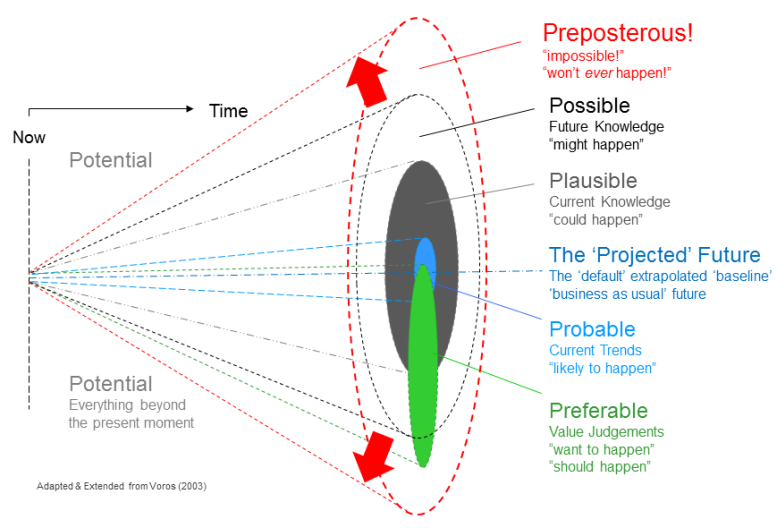
futurescone-cdb

(Voros 2017)

Rather than completely dismissing potentially unethical technologies as ‘a step too far’ and a cause for backtracking, which was my crude solution for dystopian scenarios, my primary research interview helped me address preferable futures realistically. Martin Lancaster recognised the probable and problematic trajectory of biotechnology, and instead of fighting against it, sought to direct it with notions of regulation and safety. While my position on the future of society and biotechnology is still based on a rudimentary understanding of the topic and futuring as a discipline, I believe through my research process my attitude has become more pragmatic and adaptable.

Citation

Ihde, D. 1993, Philosophy of technology: an introduction, Paragon House, New York.

stanfordonline 2013, Stanford seminar – magical thinking: fear, wonder & technology, video recording, Youtube, viewed 7 August 2018, <https://www.youtube.com/watch?v=5aKZwKFFDYw >.

Voros, J. 2017, Futures cone, The Voroscope, viewed 23 October 2018, <https://thevoroscope.com/2017/02/24/the-futures-cone-use-and-history/ >.

1C Primary Research: Interview Analysis


Martin Lancaster is a former healthcare marketing specialist who worked for international pharmaceutical company Wyeth. Prior to its consolidation with Pfizer in 2009, he was Wyeth’s regional marketing director within the Asia Pacific region for seven years (Lancaster 2018). Notable products manufactured by Wyeth include Effexor―trade name for the antidepressant Venlafaxine. While Venlafaxine is licensed for use in the treatment of major depressive disorder, generalized anxiety disorder, social phobia, and panic disorder (Australian Medicines Handbook 2013), it is also used in the treatment of narcolepsy and attention deficit-hyperactivity disorder (Stanford University School of Medicine 2007).

casebanner_wyeth

(Larmer Brown n.d.)

I interviewed Martin for his insights into the acceleration of both physical and neuro-enhancing biotechnology in the pharmaceutical industry―their marketing, regulation, ethical use, and effect on the cultural pressures of academia and the workplace. During his time as Wyeth’s marketing director for the Asia Pacific region, he was not directly involved with psychiatric drug brands or their generic equivalents, however he noted the exceptional rise in sales of pseudoephedrine (PSE). He attributed this sudden increase to its abuse as a stimulant, preceding the illegal manufacture of amphetamines.

The off-label use of certain Wyeth drugs was and remains common practice, legal when at the prescriptive discretion of general practitioners (GPs). However, when drugs are used in the complete absence of medical supervision, there is a danger that misinformation regarding side effects and dosage can lead to dangerous or even fatal consequences. Martin references Swiss physician Paracelsus (1493–1541), who laconically stated, ‘the right dosage differentiates poison from a remedy.’ He does note that there is ample information on the internet that can mitigate some of this risk. I drew a connection between this self-medicating practice and public ‘body hacking’ forums like The Immortality Institute (ImmInst.org) where members share their recreational adjustment of cognitive function through drugs and supplements (Talbot 2009).

nootropics2

(Rebel Circus n.d.)

Martin agreed that competitiveness in academia, elite sports, and the workplace has seen an exponential increase in contemporary culture, although he doesn’t believe that this will result in the commonplace use of cognitive/physical enhancers until drug regulation legally approves their use by healthy individuals. The critical barrier to their regulatory acceptance and commercial success is what Martin calls ‘an acceptable side effects profile.’ He has no doubt that in the future, science will develop drugs that surpass benefits of enhanced executive functions (alertness, attention, memory, cognitive flexibility and anti-fatigue) to target higher order executive functions (improved reasoning, problem solving, and planning). The achievement of these impressive benefits, consolidated with a satisfactory safety profile, and the post-patent price reduction on generics, is the point when the ‘performance enhancement’ market will reach critical mass.

From the perspective of someone who has observed the healthcare market shift for the last three decades, I find Martin’s future scenario to be one that maps time akin to Sohail Inayatulluh’s first pillar of futures thinking. By considering biotechnology from three dimensions―the past, present, and future― he has perceived an image of evolution and progress. That is, ‘more technology, man as the centre of the world, and a belief in rationality’ (Inayatulluh 2008).

Citation

Lancaster, M. 2018, User Profile, LinkedIn, viewed 1 October 2018, <https://www.linkedin.com/in/martin-lancaster-426a0a12/ >.

Rossi, S. (ed) 2013, Australian Medicines Handbook, The Australian Medicines Handbook Unit, Adelaide.

Stanford University School of Medicine 2007, Medications, Stanford, viewed viewed 1 October 2018, <https://web.archive.org/web/20070821090305/http://med.stanford.edu/school/Psychiatry/narcolepsy/medications.html >.

Larmer Brown n.d., Wyeth case banner, viewed 23 October 2018, <http://www.larmerbrown.com/case-studies/wyeth/ >.

Talbot, M. 2009, “Brain gain- the underground world of ‘neuroenhancing’ drugs”, The New Yorker, 27 April, viewed 26 September 2018, <https://www.newyorker.com/magazine/2009/04/27/brain-gain >.

Rebel Circus n.d., Nootropics, viewed 23 October 2018, <https://www.rebelcircus.com/blog/smart-drugs-people-pursuing-brain-enhancing-nootropics/ >.

Inayatullah, S. 2008, ‘Six pillars: futures thinking for transforming’, Foresight, vol. 10, no. 1, pp. 4-21.

Interview Transcript: Part 4

Did you notice any change in the popularity and kinds of performance enhancing drugs available during the length of your career? Do you think this has affected your company’s manufacture and marketing of these products?

During my career, the sales of pseudoephedrine (PSE) containing drugs rose dramatically. Given that this active ingredient had been on the market for many years in cough and cold medications, the sudden increase was exceptional and primarily due to the abuse of pseudoephedrine as a stimulant but more particularly as a precursor for the illegal manufacture of amphetamines.

The company introduced alternative formulations using phenylephrine (PE) instead of PSE. Meanwhile the regulatory authorities up-scheduled PSE containing medications to Pharmacist Only and requiring personal identification.

By its very nature, the abuse of prescription medications and controlled substances is difficult to quantify due to the ‘sharing’ of prescriptions, internet purchases and the illicit diversion of prescription drugs.

Only doctors can legally supply prescription drugs for off-label indications but only if there is an established medical need. Furthermore, it is illegal for drug manufacturers to promote the off-label use of prescription drugs, even if they have clinical support.

The off-label use of drugs is primarily driven by doctors who access the medical literature to seek effective therapies for their patients. Doctors will use orthodox pharmacology in the first instance but in the event of an unresponsive condition, may try off-label options.

Doctors can seek information from pharmaceutical manufacturers eg unpublished studies, but the company cannot distribute these in an unsolicited manner. The interests of the patient is paramount and the company would provide the doctor with the best available information.

While promoting off-label use of drugs is illegal, a company can always seek to formalize off label use by seeking regulatory approval for new indications with appropriate clinical support. This would naturally form part of the marketing development plans for relevant drugs.

Where do you see the development, manufacture, and marketing of performance enhancing drugs 20 years from now?

Scientific progress is unstoppable. The is no doubt that nootropic drugs that truly earn the descriptor ‘smart drugs’ will be developed with impressive benefits and safety profiles. The pricing of these novel drugs will eventually reduce as patents expire and generic copies enter the market, creating a much larger pool of potential users.

While the unknown long-term effects will still be an issue for some, the competitive nature of an increasingly knowledge/intellect driven workforce will pressure most people to conform.

This will provide huge opportunities for pharmaceutical companies to develop, manufacture and market products for a potentially massive new ‘performance enhancement’ market.

I believe the regulatory authorities will adapt to these developments by allowing the sale and marketing of drugs for non-medical, physical and cognitive performance enhancement.

Note from Martin Lancaster – ‘the opinions expressed above are mine alone and should not be attributed to any other individuals or entities.’

Interview Transcript: Part 3

Is there still value in a natural work ethic, or are neuroenhancers simply the next step in an efficient and dedicated work ethic?

Generally, patients trust their doctor implicitly to prescribe safe and effective medications to treat their health condition. They take it because they want to get well, even if they are wary of ingesting non-natural ‘chemical’ products.

I think most people would think twice about taking a drug for performance enhancement rather than for treating an ailment and would prefer a more naturalistic approach of non-drug intervention based on physical exercise and cognitive training to maintain/improve performance, with negligible risk of side effects.

However, this could change if a new generation of truly ‘smart drugs’ were developed with an acceptable safety profile. As the price of these new drugs came down, more people would seek the benefits which would in turn pressure drug-free individuals to do likewise in an increasingly competitive environment.

The biggest hurdle would be a regulatory one, requiring a seismic shift in drug regulation to approve specific physical/cognitive benefits for use by otherwise healthy individuals.

To date the Therapeutic Drugs Administration’s (TGA) position is that if a drug is unscheduled in Australia, it can’t be sold or marketed here (but can be imported for personal use (ref Personal Importation Scheme). This seriously limits the commercial potential of the nootropic market in the current situation.

The commonplace use of cognitive enhancers is probably not the ‘next step’ but will eventually happen when the pharmacology is right and the regulatory environment has responded to consumer demand.

Bio enhancements could also be expanded to include the fitness industry, where performance-enhancing drugs range from commercial supplements to the non-medical use of anabolic steroids, hormones, and stimulants. Are these two contexts comparable?

There are certainly parallels between cognitive and physical performance enhancement.

However, the use of anabolic steroids, human growth hormones and sex hormones are synonymous with cheating, personal vanity and body dysmorphia. In addition, the drugs concerned have a history of serious side effects. Accordingly, anabolic steroids are excluded from the Personal Importation Scheme. This is some heavy baggage.

If new drugs could be developed with much improved safety and ease of administration, the existing market would certainly expand in response. However, it would still be covert activity unless the regulatory authorities accept that both physical and cognitive enhancers have a place in our society for use by healthy individuals.

I think the regulatory authorities will be more amenable to cognitive enhancers given the greater value placed on intellectual ability and the historical baggage around physical enhancement and the assisted body building sub-culture.


Final Part

Note from Martin Lancaster – ‘the opinions expressed above are mine alone and should not be attributed to any other individuals or entities.’

Interview Transcript: Part 2

In competitive fields there is the risk that abstaining from biological enhancement will put you at a disadvantage. What do you envision the future of high-demand institutions will be like under these circumstances?

Employment is competitive for many workers, particularly managerial roles; likewise, academia and elite sports. Social media has also evolved a pervasive competitive dynamic that can infiltrate into almost every aspect of our social lives. These forces may have been present before but now they are dramatically amplified.

In this context, individuals will always seek ways of boosting their performance or enhancing their presentation, to give them a perceived competitive edge. The issue is, how far are they prepared to go and how this is might be regulated.

Enhancing physical and mental performance through drug intervention or invasive surgical procedures involve risks to the individual up to and including death.

It is illegal to use someone else’s prescription to access drugs or to supply a prescription medication to someone without prescription. However, the internet has facilitated the purchase of scheduled drugs from overseas and you can import unscheduled drugs such as oxiracetam (a nootropic) for personal use in Australia without medical supervision, even though it can’t be legally sold here. Interestingly Nootropil, which is closely related to oxiracetam, is Prescription Only in Australia and approved for use in the treatment of epilepsy.

Institutions that administer competition based on individual/team ability such as sports, will want to ensure fairness with respect to performance enhancing ‘artificial’ aids. These bodies will continue to enforce strict rules with enforcement mechanisms to audit compliance and deter transgression.

In academia, surveys indicate that a significant percentage of students already take cognitive enhancers (nootropic drugs) in the form of amphetamines (eg Adderall), methylphenidate (eg Ritalin), eugeroics (eg Provigil) and racetams (eg Nootropil, and oxiracetam). Perceived benefits include enhanced executive function; alertness, attention, memory, cognitive flexibility and anti-fatigue.

Improved nootropics that enhance higher order executive functions will no doubt be developed in future to improve reasoning, problem solving and planning. An acceptable side effects profile will be critical to their regulatory acceptance and commercial success and they are likely to be very expensive initially (pre-patent expiry) and beyond the reach of individuals.

However commercial and academic research institutions would see the potential of such drugs to advance intellectual development and decision making. They may wish to co-op gifted individuals who were willing to receive pharmacological intervention to fill key organizational roles. This would raise ethical issues that would need to be addressed including use of drugs in healthy people and long-term safety.

I’m not sure how teaching institutions would respond if such drugs became accessible to individuals after patent expiry. Would this be regarded as cheating and subject to controls eg random testing and penalties?


Part 3

Note from Martin Lancaster – ‘the opinions expressed above are mine alone and should not be attributed to any other individuals or entities.’

Interview Transcript: Part 1

During your time as marketing director for the Asia Pacific region of Wyeth, were you ever tasked with the marketing of psychiatric drugs like Adderall, Ritalin, or Provigil?

I was not directly involved with these drug brands or their branded or generic equivalents within the organisation. However, Wyeth is also a world leader in nutrition and we leveraged the available science around vitamins and minerals to advance claims relating to mental acuity and physical performance.

The degree to which we could promote these consumer benefits through marketing activities, much depended on the regulatory jurisdictions in which we operated. These typically varied greatly from one country to another.

Were you and your peers aware of the alternate ‘off label’ use of Wyeth’s products? Was this seen as a positive increase of the consumer pool?

Yes indeed, the ‘off label’ use of certain Wyeth drugs was not uncommon and falls to the discretion of the prescribing GP. It is perfectly legal.

Effexor as an SNRI (serotonin-norepinephrine reuptake inhibitor) class of drug that was originally indicated for clinical depression and extended for use in a range of anxiety disorders with the launch of Effexor XR (extended release).

Off label uses for Effexor when prescribed at higher doses included the treatment of hot flushes and migraine prevention.

What are your thoughts on the use of prescription drugs for non-medical purposes?

I take this to mean the use of prescription drugs, without medical supervision, where there is no condition present for which the drug is approved, in order to derive a perceived benefit for which the drug has not received approval.

I say ‘perceived benefit’ because many therapeutics are only marginally better than placebo and physiological effects can often be perceived/believed rather than established through properly designed clinical trials.

The danger with this manner of drug use is that all drugs have side effects which can be dangerous or even fatal, especially in the absence of medical supervision.

“The right dose differentiates a poison from a remedy” (Paracelsus 1493 – 1541).

Every substance can be toxic, even water which can cause hyperhydration or water toxemia which can disrupt normal brain function.

In the case of steroid use for rapid muscle gain, individuals have suffered severe long term damage due to indiscriminate use and little knowledge about dosage and side effects.

It is illegal for doctors to prescribe anabolic steroids for anything other than medical reasons and it is illegal for an individual to use these substances without a prescription. Hence most steroid use for body enhancement is conducted without medical supervision although there is ample information on the internet that can mitigate some of the risk.

As a long-term gym ‘junky’ myself, I would never use steroids as a shortcut to the results I desired but I have used various nutritional supplements. However, after many years of experience, I have concluded that a balanced, nutritious diet of wholesome minimally-processed foods, is the best foundation for enhanced physical and mental performance.


Part 2

Note from Martin Lancaster – ‘the opinions expressed above are mine alone and should not be attributed to any other individuals or entities.’


1A – Literature Review: from Blood to Plastic Surgery

After my first blog which is about my own understanding of love, the main focus of our future scenario switched to biotechnology especially in bodily enhancement for aesthetic. This is a literature review to explore one of the most popular applications of biology related to platelet in cosmetic surgery from its original potential and outcomes.

Originally platelet is functioning for haemostasis and wound healing. It constantly exists inside our blood vessel and fluid with blood circulation. The process of tissue healing contains complicated events from both intercellular and extra extracellular which is difficult to be comprehended entirely. However, it can be divided into three overlapping phases which are inflammatory, proliferative and remodelling. The inflammatory is triggered by tissue injury which leads platelet to gather and release growth factor to change its form, which can be described as activation (Eppley, Pietrzak & Blanton 2006). Then the blood in wound area becomes platelet-rich to covered the exposed vessel then initiate blood clotting to prevent blood loss. Then the living tissue could work to replace damaged tissue and reshape itself to resemble the original tissue, which is the last two phases during a wound healing. Thus, platelet is not the key in tissue healing but a protection for further process.

Before the introduction of platelet gels the development of artificial tissue sealing has already begun. Fibrin glue is one of the successful tissue sealants. Its original concept is combining fibrinogen and thrombin which effectively fixed skin grafts by Cronkite et al. and Tidrick and Warner. There is a number of sources to obtain fibrinogen from donors but it also carrying the risk of viral transmission. One reported case is a HIV transmission caused by using homologous product (Bhanot & Alex  2002). Platelet gel, which apheresis from platelet-rich plasma, is easier to produce than high concentration fibrinogen and has both the benefits of fibrin glue and the growth factor for wound healing to reduce infection, pain and blood loss. Man et al. who claimed that combining fibrin glue and platelet gels results numeral benefits in cosmetic surgical procedure including ‘the elimination of the need for drains, a reduction in postoperative pain and swelling, and improved wound healing’ during his study of 20 patients (Eppley, Pietrzak & Blanton 2006, p. 155e).

In conclusion the original function of platelets which is the capability to produce large amount in a short time to help injury healing by assembling clot. Such enhancement provides the evidence of the fact that using autologous platelet-rich plasma could accelerate soft- and hard-tissue healing in some particular situations. Yet the information from my research and the public in present still doubt about the risk of platelet gel injection and fibrin glue especially for facial cosmetic surgery since the entire process of wound healing and haemostasis is not be decrypted. However, this literature review has great inspiration on complete our future scenario in 2040.


Reference

  • Bhanot, S. & Alex, J.C. 2002, ‘Current Applications of Platelet Gels in Facial Plastic Surgery, Facial Plastic Surgery, vol. 18, no. 1, pp. 27-33.
  • Eppley, B.L., Pietrzak, W.S. & Blanton, M. 2002, Platelet-Rich Plasma: A Review of Biology and Applications in Plastic Surgery,  Plastic and Reconstrictive Surgery, vol. 118, no. 6, pp. 147e-159e.

1C – Primary Research: Interview on The Street

This interview was start after we had built our future scenario in 2040. A world which its social structure has divided into two main class. The higher class enjoy the healthy and natural life style while the living condition lower class is terrible. People in lower class use artificial method especially plastic surgery to match the appearance in higher class in order to gain more opportunity for better life although it is dangerous and even life threatening.

The aim of the interview is to investigate the social evaluation of plastic surgery as a common procedure in the field of artificial bodily enhancement. The type of my interview is semi-structed which contains a little number of constrains and examples. The interviewees are around Ultimo since it is close to my accommodation. Thus, the demographic was concentrating more on teenagers and young adults. I believe the interview can help us for our further development on future scenario and the concept for responsive prototype.

The questions in my interview are:

  • What do you think of plastic surgery, is it good or bad?
  • If the people close to you have done the plastic surgery how will you react?
  • Would you like to have plastic surgery when it becomes safe and costs less?
  • If yes, for which part of your body?

For the first question the distribution became almost fifty-fifty since it is a ‘yes or no’ question. For ‘yes’ part participants have positive or neutral opinion towards plastic surgery. While on the opposite side the most common reason is they want to be natural, so they can be ’more confident with their true self’. Others include traditions and living environment. However, in second question most of them will not against it as a respect of others choice. Apart from the interviewees who hold negative opinion for plastic surgery, most of them are willing to have it under the precondition of ‘cheap and safe’. Some of them claimed that they only accept the procedure if it is in low risks or cost. It is interesting to find out the part they want to improve can be roughly sorted by gender. The results from females are vary form lips, nose, breast and hip while males focus more on their face.

According to the result of this interview, the acceptance of plastic surgery is various to different person. And the concern about reliability is still exist even around the interviewees who hold positive attitude toward plastic surgery. During the interview some of the female participant explained the reason for breast and hip surgery as ‘looks better’. It is hard to judge their true purpose such as being confident or attracting others. In the meantime, males consider less on their body since they are likely to enhance it by physical training yet supplements are always included for nutrition plan. It seems we can hardly avoid all the artificial factor for bodily enhancement at present, which give us an opportunity to create a dystopian future in our scenario.

*All participant agreed to be recorded during the interview to publish their answer and analysis in public media.

1d. Documentation of your prototype in use

My prototype is a comparison of what a bedroom would look like for each of the two classes in our predicted future – the lower/middle class, and the upper class.

In the lower class bedroom, there is an influx of gadgets. Your room is supposedly a reflection of your mind, which explains why this room is very messy – as this class of people lead very chaotic and unhealthy lifestyles due to difficult circumstances.  It can be seen that they are willing to spend most of their money on gadgets and technology (which can be seen strewn across the entire room), however they aren’t as willing to spend their money on necessities, like a bedhead (in this case, this person just has their mattress on the floor). Their walls are also very dilapidated, and there are stains all over the floor.

All of the technology they have is in an attempt to try and recreate a “back-to-the-land” lifestyle that the upper class leads. For example, they have a huge projection of a “window” looking out on “nature” (as most rooms in lower class areas are windowless and there isn’t any nature in the cities) a solarium to make them look “naturally” sun-kissed, and a “sleep-hacker” to maintain their health while they are sleeping.

In the pictures below you can see what a day in the life of this person would look like – I’ve modelled the person with clay. They would be spending a lot of time in their room, specifically using their technology.

IMG_1120IMG_1119IMG_1121IMG_1118IMG_1115IMG_1116

The room of the upper class person is very minimal. This is reflective of the natural, back-to-the-land lifestyle they have.

On a daily basis they would spend time doing yoga and meditating – occasionally looking out their window and onto the nature outside. In their room is a real plant (to maintain high oxygen levels), a yoga matt, and a Japanese floor mattress. They wouldn’t be spending a lot of time in their room – the majority of their time spent there would be sleeping, otherwise they would be outdoors and in nature.

IMG_1114IMG_1113IMG_1112

1D – Further Introduction of Final Prototype

As in our future scenario in 2040 lower class is suffering from dense population, polluted environment and high cost of quality resource like fresh water & powered electricity. In the meantime, they still keep using artificial bodily enhancement method with high risk. The most common method is plastic surgery which already abandoned by higher class. Some of them even obsessed with the artificial manipulation to match the appearance of higher class which is natural and healthy.

To introduce my prototype better in our scenario I was imagining a group of people wants to alter the situation under such distinct social structure. They come from higher class and founded a company called Cube. The company would like to share the water and electricity with lower class in order to improve their living quality. However, the company will not let the lower class just sit in their room abd receive the resources with no action. Then they designed a home workout system Life Cube to let them ‘earn’ the resources they provide.


I would like to set the Life Cube as a part of those resource trading system which the clients can directly interact with. How the system work is: Cube is testing the system in a certain area near the storage location so that they can connect the power and water to buildings with lower cost. Then they send out a team to apply the Life Cube to each room inside the building. The clients have to finish certain amount of training during a session to get the credit then use it trade water and electricity. All the features of Life Cube such as aluminum cube shell, the high durability spiral iron, remote track and multi-purpose ‘Pyramid Handle’ are aiming to create a complete workout experience for clients in order to enhance each part of their body in a physical way. Cube Display is a built-in operation system for resource trading and personal information. As I mentioned in the presentation the material for the display is low resolution to reduce the cost for each product. The only feature I did not show in the presentation is the corners of Life Cube is covered with cover for safety reason. Yet there are some issues I have not consider including the repairing and a tutorial for clients to introduce the function of Life Cube.

The purpose of my prototype is using the love of sharing to promote self-love. Resident in lower class will enjoy high quality resources shared by higher class while in a self-motivate way although it looks like they are forced to do so. Then let them understand the sense of healthy life style. Another reason I set my prototype in a pre-set background of company and the stage of testing is that the prototype itself is not a revolutionary concept under the scenario we create and the rate of success is unpredictable. This final outcome was the combination of my previous idea which carrying the concept of modularity, low profile and motivation.