1B Positioning

I have been mostly uninvolved with future-related discourse in media and academia up until the commencement of this subject. Having been introduced to futures thinking and made to address my untouched critical thinking skills, I still consider my thoughts on the future to be quite rudimentary.

Regarding the acceleration of body-modification technology, my initial position perpetuated contemporary attitudes towards body image, human capability, and humanity. Society would remain essentially the same as the present day, with a trajectory of self-improvement via bodily enhancement, but with the benefit of more sophisticated technological conveniences. Drawing from the current state of society while being mindful of ‘the amplifying/magnifying power of technologies’ (Ihde 1993), I was focused on predictive accuracy.

The research that I undertook when scanning the horizon of ‘love’ as a futuring theme focused first on AI, before shifting to biotechnology. Despite this dramatic leap in the subject matter of my research and group scenario, I found that there was an element of caution and cynicism that pervaded both. Australian futurist Genevieve Bell highlighted this ‘irrational fear of a relationship with technology’ in her seminar Magical Thinking: Fear, Wonder & Technology (stanfordonline 2013). I saw reason in her suggestion that the ‘death of magic’ in the face of science and rationality is the source of unease that prompts dystopian stories about technology.

To draw a comparison between AI and biotechnology, the legacy of the Luddites as recounted by Bell expresses the ongoing concern that new technology replaces things naturally human. In the context of biotechnology, the concern is that technologically-enhanced humans will unfairly outclass ‘natural’ humans. My group’s dystopian scenario, A Cut Above the Rest, reflects society’s obsession with biotechnology and the abandonment of individuality and authenticity for success.

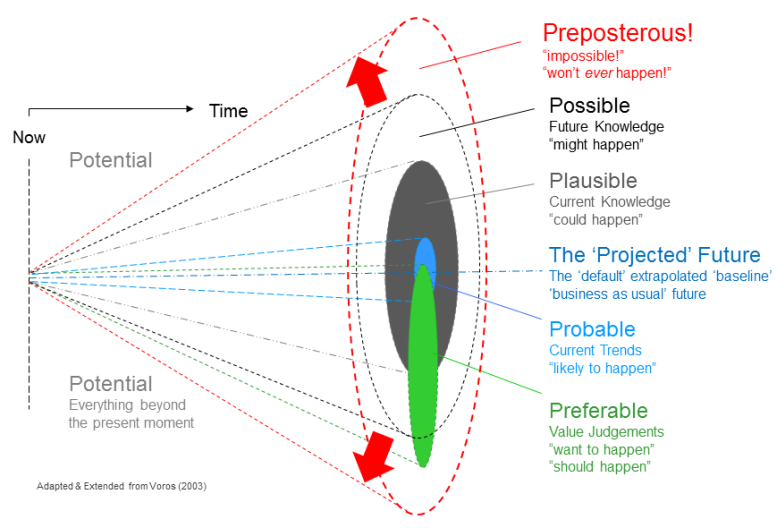
In the creation of my own prototype, I came to better understand the purpose of future thinking, particularly regarding the creation of speculative objects and the narratives they imply. The future can be many different things―in the case of dystopian stories like A Cut Above the Rest, a problem is being identified that requires a solution, if such a future is to be avoided. While cynical, these narratives are not fatalistic, instead challenging its audience to address undesirable variables and steer humanity towards a preferred future instead. This productive method of future thinking altered my first impression of the discipline, which simply sought the most accurate prediction of the future.

futurescone-cdb

(Voros 2017)

Rather than completely dismissing potentially unethical technologies as ‘a step too far’ and a cause for backtracking, which was my crude solution for dystopian scenarios, my primary research interview helped me address preferable futures realistically. Martin Lancaster recognised the probable and problematic trajectory of biotechnology, and instead of fighting against it, sought to direct it with notions of regulation and safety. While my position on the future of society and biotechnology is still based on a rudimentary understanding of the topic and futuring as a discipline, I believe through my research process my attitude has become more pragmatic and adaptable.

Citation

Ihde, D. 1993, Philosophy of technology: an introduction, Paragon House, New York.

stanfordonline 2013, Stanford seminar – magical thinking: fear, wonder & technology, video recording, Youtube, viewed 7 August 2018, <https://www.youtube.com/watch?v=5aKZwKFFDYw >.

Voros, J. 2017, Futures cone, The Voroscope, viewed 23 October 2018, <https://thevoroscope.com/2017/02/24/the-futures-cone-use-and-history/ >.

1C Primary Research: Interview Analysis


Martin Lancaster is a former healthcare marketing specialist who worked for international pharmaceutical company Wyeth. Prior to its consolidation with Pfizer in 2009, he was Wyeth’s regional marketing director within the Asia Pacific region for seven years (Lancaster 2018). Notable products manufactured by Wyeth include Effexor―trade name for the antidepressant Venlafaxine. While Venlafaxine is licensed for use in the treatment of major depressive disorder, generalized anxiety disorder, social phobia, and panic disorder (Australian Medicines Handbook 2013), it is also used in the treatment of narcolepsy and attention deficit-hyperactivity disorder (Stanford University School of Medicine 2007).

casebanner_wyeth

(Larmer Brown n.d.)

I interviewed Martin for his insights into the acceleration of both physical and neuro-enhancing biotechnology in the pharmaceutical industry―their marketing, regulation, ethical use, and effect on the cultural pressures of academia and the workplace. During his time as Wyeth’s marketing director for the Asia Pacific region, he was not directly involved with psychiatric drug brands or their generic equivalents, however he noted the exceptional rise in sales of pseudoephedrine (PSE). He attributed this sudden increase to its abuse as a stimulant, preceding the illegal manufacture of amphetamines.

The off-label use of certain Wyeth drugs was and remains common practice, legal when at the prescriptive discretion of general practitioners (GPs). However, when drugs are used in the complete absence of medical supervision, there is a danger that misinformation regarding side effects and dosage can lead to dangerous or even fatal consequences. Martin references Swiss physician Paracelsus (1493–1541), who laconically stated, ‘the right dosage differentiates poison from a remedy.’ He does note that there is ample information on the internet that can mitigate some of this risk. I drew a connection between this self-medicating practice and public ‘body hacking’ forums like The Immortality Institute (ImmInst.org) where members share their recreational adjustment of cognitive function through drugs and supplements (Talbot 2009).

nootropics2

(Rebel Circus n.d.)

Martin agreed that competitiveness in academia, elite sports, and the workplace has seen an exponential increase in contemporary culture, although he doesn’t believe that this will result in the commonplace use of cognitive/physical enhancers until drug regulation legally approves their use by healthy individuals. The critical barrier to their regulatory acceptance and commercial success is what Martin calls ‘an acceptable side effects profile.’ He has no doubt that in the future, science will develop drugs that surpass benefits of enhanced executive functions (alertness, attention, memory, cognitive flexibility and anti-fatigue) to target higher order executive functions (improved reasoning, problem solving, and planning). The achievement of these impressive benefits, consolidated with a satisfactory safety profile, and the post-patent price reduction on generics, is the point when the ‘performance enhancement’ market will reach critical mass.

From the perspective of someone who has observed the healthcare market shift for the last three decades, I find Martin’s future scenario to be one that maps time akin to Sohail Inayatulluh’s first pillar of futures thinking. By considering biotechnology from three dimensions―the past, present, and future― he has perceived an image of evolution and progress. That is, ‘more technology, man as the centre of the world, and a belief in rationality’ (Inayatulluh 2008).

Citation

Lancaster, M. 2018, User Profile, LinkedIn, viewed 1 October 2018, <https://www.linkedin.com/in/martin-lancaster-426a0a12/ >.

Rossi, S. (ed) 2013, Australian Medicines Handbook, The Australian Medicines Handbook Unit, Adelaide.

Stanford University School of Medicine 2007, Medications, Stanford, viewed viewed 1 October 2018, <https://web.archive.org/web/20070821090305/http://med.stanford.edu/school/Psychiatry/narcolepsy/medications.html >.

Larmer Brown n.d., Wyeth case banner, viewed 23 October 2018, <http://www.larmerbrown.com/case-studies/wyeth/ >.

Talbot, M. 2009, “Brain gain- the underground world of ‘neuroenhancing’ drugs”, The New Yorker, 27 April, viewed 26 September 2018, <https://www.newyorker.com/magazine/2009/04/27/brain-gain >.

Rebel Circus n.d., Nootropics, viewed 23 October 2018, <https://www.rebelcircus.com/blog/smart-drugs-people-pursuing-brain-enhancing-nootropics/ >.

Inayatullah, S. 2008, ‘Six pillars: futures thinking for transforming’, Foresight, vol. 10, no. 1, pp. 4-21.

Interview Transcript: Part 4

Did you notice any change in the popularity and kinds of performance enhancing drugs available during the length of your career? Do you think this has affected your company’s manufacture and marketing of these products?

During my career, the sales of pseudoephedrine (PSE) containing drugs rose dramatically. Given that this active ingredient had been on the market for many years in cough and cold medications, the sudden increase was exceptional and primarily due to the abuse of pseudoephedrine as a stimulant but more particularly as a precursor for the illegal manufacture of amphetamines.

The company introduced alternative formulations using phenylephrine (PE) instead of PSE. Meanwhile the regulatory authorities up-scheduled PSE containing medications to Pharmacist Only and requiring personal identification.

By its very nature, the abuse of prescription medications and controlled substances is difficult to quantify due to the ‘sharing’ of prescriptions, internet purchases and the illicit diversion of prescription drugs.

Only doctors can legally supply prescription drugs for off-label indications but only if there is an established medical need. Furthermore, it is illegal for drug manufacturers to promote the off-label use of prescription drugs, even if they have clinical support.

The off-label use of drugs is primarily driven by doctors who access the medical literature to seek effective therapies for their patients. Doctors will use orthodox pharmacology in the first instance but in the event of an unresponsive condition, may try off-label options.

Doctors can seek information from pharmaceutical manufacturers eg unpublished studies, but the company cannot distribute these in an unsolicited manner. The interests of the patient is paramount and the company would provide the doctor with the best available information.

While promoting off-label use of drugs is illegal, a company can always seek to formalize off label use by seeking regulatory approval for new indications with appropriate clinical support. This would naturally form part of the marketing development plans for relevant drugs.

Where do you see the development, manufacture, and marketing of performance enhancing drugs 20 years from now?

Scientific progress is unstoppable. The is no doubt that nootropic drugs that truly earn the descriptor ‘smart drugs’ will be developed with impressive benefits and safety profiles. The pricing of these novel drugs will eventually reduce as patents expire and generic copies enter the market, creating a much larger pool of potential users.

While the unknown long-term effects will still be an issue for some, the competitive nature of an increasingly knowledge/intellect driven workforce will pressure most people to conform.

This will provide huge opportunities for pharmaceutical companies to develop, manufacture and market products for a potentially massive new ‘performance enhancement’ market.

I believe the regulatory authorities will adapt to these developments by allowing the sale and marketing of drugs for non-medical, physical and cognitive performance enhancement.

Note from Martin Lancaster – ‘the opinions expressed above are mine alone and should not be attributed to any other individuals or entities.’

Interview Transcript: Part 3

Is there still value in a natural work ethic, or are neuroenhancers simply the next step in an efficient and dedicated work ethic?

Generally, patients trust their doctor implicitly to prescribe safe and effective medications to treat their health condition. They take it because they want to get well, even if they are wary of ingesting non-natural ‘chemical’ products.

I think most people would think twice about taking a drug for performance enhancement rather than for treating an ailment and would prefer a more naturalistic approach of non-drug intervention based on physical exercise and cognitive training to maintain/improve performance, with negligible risk of side effects.

However, this could change if a new generation of truly ‘smart drugs’ were developed with an acceptable safety profile. As the price of these new drugs came down, more people would seek the benefits which would in turn pressure drug-free individuals to do likewise in an increasingly competitive environment.

The biggest hurdle would be a regulatory one, requiring a seismic shift in drug regulation to approve specific physical/cognitive benefits for use by otherwise healthy individuals.

To date the Therapeutic Drugs Administration’s (TGA) position is that if a drug is unscheduled in Australia, it can’t be sold or marketed here (but can be imported for personal use (ref Personal Importation Scheme). This seriously limits the commercial potential of the nootropic market in the current situation.

The commonplace use of cognitive enhancers is probably not the ‘next step’ but will eventually happen when the pharmacology is right and the regulatory environment has responded to consumer demand.

Bio enhancements could also be expanded to include the fitness industry, where performance-enhancing drugs range from commercial supplements to the non-medical use of anabolic steroids, hormones, and stimulants. Are these two contexts comparable?

There are certainly parallels between cognitive and physical performance enhancement.

However, the use of anabolic steroids, human growth hormones and sex hormones are synonymous with cheating, personal vanity and body dysmorphia. In addition, the drugs concerned have a history of serious side effects. Accordingly, anabolic steroids are excluded from the Personal Importation Scheme. This is some heavy baggage.

If new drugs could be developed with much improved safety and ease of administration, the existing market would certainly expand in response. However, it would still be covert activity unless the regulatory authorities accept that both physical and cognitive enhancers have a place in our society for use by healthy individuals.

I think the regulatory authorities will be more amenable to cognitive enhancers given the greater value placed on intellectual ability and the historical baggage around physical enhancement and the assisted body building sub-culture.


Final Part

Note from Martin Lancaster – ‘the opinions expressed above are mine alone and should not be attributed to any other individuals or entities.’

Interview Transcript: Part 2

In competitive fields there is the risk that abstaining from biological enhancement will put you at a disadvantage. What do you envision the future of high-demand institutions will be like under these circumstances?

Employment is competitive for many workers, particularly managerial roles; likewise, academia and elite sports. Social media has also evolved a pervasive competitive dynamic that can infiltrate into almost every aspect of our social lives. These forces may have been present before but now they are dramatically amplified.

In this context, individuals will always seek ways of boosting their performance or enhancing their presentation, to give them a perceived competitive edge. The issue is, how far are they prepared to go and how this is might be regulated.

Enhancing physical and mental performance through drug intervention or invasive surgical procedures involve risks to the individual up to and including death.

It is illegal to use someone else’s prescription to access drugs or to supply a prescription medication to someone without prescription. However, the internet has facilitated the purchase of scheduled drugs from overseas and you can import unscheduled drugs such as oxiracetam (a nootropic) for personal use in Australia without medical supervision, even though it can’t be legally sold here. Interestingly Nootropil, which is closely related to oxiracetam, is Prescription Only in Australia and approved for use in the treatment of epilepsy.

Institutions that administer competition based on individual/team ability such as sports, will want to ensure fairness with respect to performance enhancing ‘artificial’ aids. These bodies will continue to enforce strict rules with enforcement mechanisms to audit compliance and deter transgression.

In academia, surveys indicate that a significant percentage of students already take cognitive enhancers (nootropic drugs) in the form of amphetamines (eg Adderall), methylphenidate (eg Ritalin), eugeroics (eg Provigil) and racetams (eg Nootropil, and oxiracetam). Perceived benefits include enhanced executive function; alertness, attention, memory, cognitive flexibility and anti-fatigue.

Improved nootropics that enhance higher order executive functions will no doubt be developed in future to improve reasoning, problem solving and planning. An acceptable side effects profile will be critical to their regulatory acceptance and commercial success and they are likely to be very expensive initially (pre-patent expiry) and beyond the reach of individuals.

However commercial and academic research institutions would see the potential of such drugs to advance intellectual development and decision making. They may wish to co-op gifted individuals who were willing to receive pharmacological intervention to fill key organizational roles. This would raise ethical issues that would need to be addressed including use of drugs in healthy people and long-term safety.

I’m not sure how teaching institutions would respond if such drugs became accessible to individuals after patent expiry. Would this be regarded as cheating and subject to controls eg random testing and penalties?


Part 3

Note from Martin Lancaster – ‘the opinions expressed above are mine alone and should not be attributed to any other individuals or entities.’

Interview Transcript: Part 1

During your time as marketing director for the Asia Pacific region of Wyeth, were you ever tasked with the marketing of psychiatric drugs like Adderall, Ritalin, or Provigil?

I was not directly involved with these drug brands or their branded or generic equivalents within the organisation. However, Wyeth is also a world leader in nutrition and we leveraged the available science around vitamins and minerals to advance claims relating to mental acuity and physical performance.

The degree to which we could promote these consumer benefits through marketing activities, much depended on the regulatory jurisdictions in which we operated. These typically varied greatly from one country to another.

Were you and your peers aware of the alternate ‘off label’ use of Wyeth’s products? Was this seen as a positive increase of the consumer pool?

Yes indeed, the ‘off label’ use of certain Wyeth drugs was not uncommon and falls to the discretion of the prescribing GP. It is perfectly legal.

Effexor as an SNRI (serotonin-norepinephrine reuptake inhibitor) class of drug that was originally indicated for clinical depression and extended for use in a range of anxiety disorders with the launch of Effexor XR (extended release).

Off label uses for Effexor when prescribed at higher doses included the treatment of hot flushes and migraine prevention.

What are your thoughts on the use of prescription drugs for non-medical purposes?

I take this to mean the use of prescription drugs, without medical supervision, where there is no condition present for which the drug is approved, in order to derive a perceived benefit for which the drug has not received approval.

I say ‘perceived benefit’ because many therapeutics are only marginally better than placebo and physiological effects can often be perceived/believed rather than established through properly designed clinical trials.

The danger with this manner of drug use is that all drugs have side effects which can be dangerous or even fatal, especially in the absence of medical supervision.

“The right dose differentiates a poison from a remedy” (Paracelsus 1493 – 1541).

Every substance can be toxic, even water which can cause hyperhydration or water toxemia which can disrupt normal brain function.

In the case of steroid use for rapid muscle gain, individuals have suffered severe long term damage due to indiscriminate use and little knowledge about dosage and side effects.

It is illegal for doctors to prescribe anabolic steroids for anything other than medical reasons and it is illegal for an individual to use these substances without a prescription. Hence most steroid use for body enhancement is conducted without medical supervision although there is ample information on the internet that can mitigate some of the risk.

As a long-term gym ‘junky’ myself, I would never use steroids as a shortcut to the results I desired but I have used various nutritional supplements. However, after many years of experience, I have concluded that a balanced, nutritious diet of wholesome minimally-processed foods, is the best foundation for enhanced physical and mental performance.


Part 2

Note from Martin Lancaster – ‘the opinions expressed above are mine alone and should not be attributed to any other individuals or entities.’


Final Prototype: Augmented ‘Lifestyle’ Reality

Highlighted Scenario:

In 2040, physical appearance is highly valuable while technological advancements are being turned away, making ‘back to nature’ lifestyle heavily promoted. The border between socio-economy class is somehow clearly visible where the richer ones are capable to accomplish more advanced, natural safe care which enables them to afford balanced organic diet, live in a clean environment, and advanced technologies that facilitate them to get their jobs done easier.

On the other hand, the poorer classes are fully aware on the difference. They found themselves struggling to adjust with the lifestyle. Alternatively, they try to utilize biological augmentation as a possible self-enhancement alternative. However, biological augmentation itself still surrounded by controversies where some group of people seen it as unethical and against the religion. This lead some private company as an opportunity to create an alternative solution by promoting consumerism.

Basically, the idea behind this object is to promote consumers (the poorer classes) to experience different lifestyle that is similar with the higher classes, which encouraging them to feel equal and promoting materialistic lifestyle. Mentioned lifestyle is including social behavior, fashion sense, exercise routine, and eating habit.

standard

Simplified scenario mind map.


Capability:

The badge is actually a mini smart camera with transmission capability that fully functional to recognize its surrounding’s social status and to gather the behavior and lifestyle habit. It has automatic detection feature which allow users to obtain a sensation of living the riches’ lifestyle through visual and feeling. Within the camera form, it enables user to gather data within user’s range of view. Its transmission capability extend data gathering by connected to any electronic devices that transmit data such as: CCTV, radio, and internet.

280077

The camera transmitter prototype.

To make use of the product, the only thing that users need to do is register their lifestyle preference and current lifestyle. The detection feature will capture any person within its range that has the most similar lifestyle with user’s preference. This product also has a capability to record target’s behavior and its surrounding area. The recorded data will be used as an augmentation reality where user is enabled to live as the riches.

camera

Illustration showing the transmission capability towards nearby CCTVs.

As the goal of this product is to promote consumerism, this product target encouraged users to feel the luxury of having higher level lifestyle. By giving them the experiences, they will also be persuaded to be more materialistic as a form of self-love.


How it works:

This product mainly relies on the badge camera part, however it also supplemented with an augmented reality goggles that enables users to live in a scenario where they are the riches. This goggles manipulates user’s sensory and nervous system, which generates different image and feeling inside their head. The badge is acting as the camera recorder that collects data and gesture while the glasses become an augmentation reality that enables users to experience living in higher social class. Both objects are connected to each other wirelessly and can be easily turned on or off at will.

280075

Augmented goggles prototype.

When the goggles is activated, users will visualise themselves living as the targeted richer subject. They are living in their desired world where everything they do will look, taste, and feel like what they want.

goggles.jpg

Illustration showing the how visible object seen and experienced differently.


Here are some images to show clarify the functionality of both prototype objects:

pizza

bedroom.jpg

car.jpg


Direction we are heading:

From this scenario and this possible object, the future heavily revolves around technology and people starts to become more self-focused and goal orientated where people are willing to do anything to achieve their goal. The society will become materialistic as they value luxury. People will become more individualistic as they find themselves struggle to achieve self-love. However on the other hand, love will feel the same, but just the way it perceived and received will have slight difference.

Prototype Brainstorming

The background behind my possible idea is to create a condition where private companies are having tight competition to sell their products as the alternative solution towards the beauty standard grouping. In this scenario, advertisement hold a huge significant role where it persuades people to consume their product, no matter how useless the product is.

During the class activity, I came up with a few different ideas for the speculative futuristic prototype objects:

ide

List of possible ideas from class activity

From those lists, I feel that the fashion recognition would be appropriate as a response to the assessment brief and my previous blog researches.

The fashion recognition takes form as a mini-camera badge where it fully functional to recognize existed fashion. It has automatic detection feature which allow users to obtain pictures of their favorite clothes even when they not even see it.

To make use of the product, the only thing that users need to do is register their fashion preference. The detection feature will capture any clothing that match the registered preference as long it exists within the product’s range of view. This product also has a capability to connect user’s eyes and enabling them to visualise their interested fashion style, supplementing them with the product’s brand, release date, and price. These captured pictures will be saved inside an inserted USB drive and could also be previewed virtually in pinterest board format. Each picture will generate direct link to the actual clothing brand or company and enable users to easily online purchase it.

The object is also supported with an augmentation reality where users are capable to visualise themselves wearing, walking around, and creating a scenario where they are utilizing their preferred clothing line. This capability is designed to encourage people to be even more consumerism.

Prototype

Concept showing how the badge would work

However, as the concept developed, I found some issues regarding the object’s functionality. I somehow feel the function is not futuristic enough as its capability can easily be replaced by existed technologies; smartphones and internet. Beside that, the ‘forced’ advertisement I tried to implemented does not really make sense and suitable for the scenario. I also got feedback stating that the idea does not really make sense since it basically forcing consumers, who are basically from lower classes to purchase some clothing that not even necessary for them.

Due to this, this idea is later scrapped but this scenario concept idea will be developed even further and more futuristic for my final prototype object.

Primary Research: Interview Interpretation

I have been friend with Inez for more than two years and I would say that I know her pretty well. She has been dealing with love related issues, especially around friends and her family which led her to be more mature and spoken out some of her amazing perspective.

One thing that I really like about her opinion is ‘love has been felt the same and it cannot be changed’. I completely agree that the way we receive love is different for each individual but the way our heart feel it will be the same, in general. I also agree with her saying that love has gotten better treatment nowadays, especially for the LGBTQ community. Moreover, I also feel people has put more respect for self-love, like woman empowering, color-based equality, etc., the stigma about woman has to stay at home while the man needs to work outside to pay the bill has been broken as some roles has been reversed just because they are capable to choose what they like and what they want.

This interview has also opened a new perspective for me. I used to believe that technology will always make human life better, even though some of them have negative effects. However, her opinion about how technology create a distance between human relationship is pretty realistic as we ourselves has been dealing with that issue. Technology is something that keep getting advanced these days, by this, I believe the human-to-human relationship will also face some new problems. I am completely agree with her that in 2040, no matter how advanced the technology, it will affect how people interact, but it will not change how people love each other as a human being.

From this interview, I am starting to imaging a future where people are pressured to fulfill society’s demand as requirement to have a ‘normal’ life­ (in my scenario, the beauty standard), which lead them to struggle to achieve self-love. People will be too focused to fit in and desperate to find an achievable alternative solution. From the statement ‘technology will always get more advanced’ made me speculate that there will be some people who trying to obtain profit from this desperate cond­­­ition. Some people will pretend to create a solution while it actually it just worsens the situation. Referring to my second main blog post, people will still accept that solutions because its human nature as an act of love to fight for their desire.

Through their Design Critique reading, Dunne and Raby managed to explore and deeply explain what kind of design that estimated to be valuable and interest both market and customers. We have recently become interested in the idea of critical shopping (Dunne & Raby 2013). This mean people will seek for an alternative design where every single of their needs could be simply achievable in the possible simplest way. Moreover, advertising will become the main influencer of our choices.

Also, in my scenario, I feel some people will become materialistic to fulfill their emptiness due to lack of self-love. This will create a condition where people are obsessed and fully desired to be equal and accepted in the society. Through this condition, people will become clueless about what they want and desperately need technology that would fill their emptiness. From this on, I would like to imagine my prototype as a ‘solution’ that actually create a new problem.

References:

Dunne, Anthony & Raby, Fiona, 2013, ‘Design as Critique,’ in Speculate Anything, Cambridge, MIT Press, pp. 33-46.


Interview Transcript

For this interview, I am trying to get into a perspective of someone that is close to my age group. With this choice, I believe it would help me to more visualise some familiar technologies that relevant to the scenario and based on an existed technology. I end up interviewing my peer, who is a second-year animation student, Inez. Here is my interview with her and her perspective towards love, technology, and the future of both.

Q: Hello! Thank you for being part of this interview. You are busy with uni projects, right?

A: Nah, that’s alright! Let’s start!

Q: Sure, let’s start with the basic question. What do you think love is?

A: Love is something that is not a tangible thing that experienced by people. It could be a desire, passion, or a relationship between two people depending how they living their life. Love could come in a lot of different ways.

Q: You mentioned something about two people. Do you think love is possible to occur if there is only one person?

A: It is possible, but it will be different.

Q: What do you mean by that?

A: Um, you know love because you have been feeling it since the beginning of time and everything, but in relationship you expect someone to feel, to do something, But, it feels like a game where you don’t know what (he) gonna feel or do. It is a two ways of perspective feeling. But if we talk about self-love, you are doing it, receiving something from yourself. You are the one that know what you want and all you expect is yourself, do you get what I mean?

Q: Ah yeah. So, are you trying to say that self-love is different from relationship between two people?

A: Yeah definitely! Love is always different. Even friendship is love but it is different right? It just different amount, different feeling of love that you receive from either yourself or other.

Q: Um, so what do you think self-love is? Do you think that you have given enough love for yourself?

A: I think everyone will give enough amount of love for themselves. Until something happens.

Q: What do you mean by that?

A: It is actually based on my experience, but it is formed by your entire environment, the way you deal with things, people who surround you. But as far as I know people love themselves until something happens, something traumatizes them affecting their way. Like they had something that making them to start doubting themselves, like the person they are right now is not perfect. But yeah, loving yourself is what 2018 about. It is about accepting yourself even if you are transsexual, gay, queer, or whatever that is.

Q: Alright, but these days, some people are choosing to focus on themselves. Some people choose to have a good career, following their dream and passion. Do you think that it is part of self-love?

A: Like what?

Q: Some people choose to not get married to achieve something that they wanted to do. Like Jennifer Aniston chooses to not have any child because she wants to be a huge star and having her own family will affect her career because she stated that she won’t be able to balance her life. Do you agree with that?

A: Here’s the thing about self-love, when you love yourself too for too much, you feel that you don’t need somebody else or you feel enough already because you already found out what you are as an identity. So it’s kinda like saying that identity as love. People have different personality, people have different ways of thinking. If they think they can achieve, getting what they want just by having themselves is okay. But the thing is that they just want to find the idea of what life is. If they think that love is something that they can give to themselves and they don’t need people or things or relationship is okay, but most of the time people have things that distract themselves. Some people don’t really have human-to-human relationship, maybe more like human-to-thing.

Q: Human-to-thing?

A: It is like human to dream, human to passion. Like they know what they like, they know what they want to do, they don’t need human to tell them. They just feel ‘this is what this is’.

Q: That’s a good answer. But they thing about love nowadays is there also thing called love to inanimate objects. I’m not sure how to explain that, but I am trying to say objects that escalate your status like money etc. Its more like materialistic kind of thing. Do you agree with that way of thinking? Is it part of self-love?

A: It is a part of love. It just doesn’t have lust. The thing about love is that you want to experience sexual stuffs. But when you don’t think about those sexual stuffs, it’s still loves but it’s a different thing. Like for example you love your mom but you don’t think her in any of those way. The same way exists for those materials, objects stuffs. It is like you treasure them a lot as something that has been part of your life and it takes process to achieve them. You keep them as a precious thing. So, I think it is self-love because you have desire to own it, to make it as a part of your life.

Q: That’s an amazing answer! So, about this subject. We are talking about future. What do you think love will be in future? What will change about love?

A: A lot of things will happen. Love itself has improved already these days like people is okay with gay, bi(sexual), there also been a lot of LGBTQ movement going on. So I don’t think love can be improved more than that just because right now it feels enough for everything.

Q: How about technology? Will there be technology that invented to improve those stuffs?

A: What are those stuffs?

Q: The LGBTQ movement stuffs. Something that can be used to support the movement.

A: I don’t get why there need to be technology to improve love. I mean I get it that It makes thing easier. But you lost the human touch relationship because of that. You could think “Ah, I could connect with people because I have phone” but you don’t actually connect with them because you don’t really know what they feel. But in the past, when you like a girl, like you have to send a message to her. You have to go to the post office then wait for a week and such. The feeling of love that you get was actually bigger than you feel nowadays. Like for example, Tinder. It is basically you text people. It just that you don’t get the same amount of love than in the past. So if you are saying that you want to make a technology to improve relationship between human, it will feel okay during that time just because we are so used to have these modern technologies. But again, personally if you compare to how it was in the past, it is simpler. Love felt more real than now.

Q: Do you think we are heading toward that direction? (technology becomes an obstacle between human relationship and having negative effect towards love).

A: We are! We are going into technological kind of direction. Um, I think if they are trying to create another technology, they maybe create something that enables you to not be physically there anymore. It could be just like a VR, you don’t have to actually meet the person to get into relationship. I don’t know if that is a good thing,

Q: So basically you are saying if technology is getting more advance, people will be distanced. But do you think people will still use those technologies?

A: Yeah!

Q: Even if they don’t connect with people?

A: Because I live in the time where there wasn’t any advanced technology. I live in a time where I didn’t have phone that I can message people all the time. But like kids nowadays are about technologies, they watch ipad as tv and stuffs. It just a normal thing for them. That is why some old people used to say ‘back in my time, we don’t have this, this, and this’, I think the bigger the technologies are, it won’t guarantee that things will be better.

Q; Okay. Connected to my future scenario, my group develop a scenario where beauty standard becomes a socio currency. This scenario refers to a condition where resources are getting harder to be obtained, which only achievable by the riches where the poor are trying to fit in while achieving that beauty standard, but limited due to the economic issue. Do you think that it will be our possible future?

A: If it a self-love? Why there should be any beauty standard? If they really love themselves, they will not think about beauty standard anymore. It will be more about accepting yourself, your identity as who you are. Accepting whatever you look. So where is the self-love if they still focusing on the look.

Q: So, do you think love is not getting improved in this scenario?

A: I don’t get why you keep saying love need to be improved. Love is not technology. It cannot be improved because it is not something that human create. Feeling love is something that you feel for yourself. The way you love people and the way I love people is different. For example, ‘I can receive this big amount of love while you are receiving smaller amount of love but you still think it is love because it’s the biggest love you ever received from people”. What I am trying to say is, love is about what you feel. It cannot be improved because it just happens the way it is.

Q: So, what do you expect from love in the future that are technology related?

A: I don’t think there is none. Technology will still be there because we are so used to it, and living without one will be so weird. I think what to be expect is how people limit themselves from technology. Back to the materialistic thing, it feels like people value their phone more than people surround them. So, if you are making a scenario where there needed technology to support or improve human love, out future is doomed. But if that happens, the only needed technology is the ones that could make human-to-human relationship to work. It might be ironic, but it might be a technology versus technology.

Q: Based on your answer, I am more thinking about the worst-case scenario. What is the worse one that related to technology?

A: It would be like I said. You might have a first date, but its not human-to-human. It will be you love things, more than you love actual human. And you value the things rather than your human relationship. Its like you love the technology but you thought you love human, but it actually a technology that making up that image and you don’t even actually know that person as a human.

Q: Alright that’s it! You have given a lot of wonderful answers. Thank you so much for your time!

A: Oh that’s it? You are welcome! Its been a pleasure to help!